

In the realm of modern technology, intelligent vision solutions have emerged as a cornerstone for various industries, from manufacturing to healthcare. One of the fundamental tasks within these solutions is image segmentation, a process that divides an image into multiple segments or regions to simplify its analysis. As a leading supplier of intelligent vision solutions, I am excited to delve into the intricacies of how these solutions segment images.
Understanding Image Segmentation
Image segmentation is the process of partitioning a digital image into multiple segments (sets of pixels, also known as super - pixels). The goal is to simplify and/or change the representation of an image into something that is more meaningful and easier to analyze. For instance, in a medical image, segmentation can be used to separate different organs, tumors, or tissues. In industrial applications, it can help identify defects, parts, or specific features on a product.
Techniques for Image Segmentation in Intelligent Vision Solutions
Thresholding
Thresholding is one of the simplest and most widely used methods for image segmentation. It involves comparing each pixel in an image to a predefined threshold value. Pixels with values above the threshold are assigned to one class, and those below are assigned to another. For example, in a grayscale image, if the threshold is set at 128 (on a scale of 0 - 255), pixels with values from 0 - 127 might be considered part of the background, while pixels from 128 - 255 are part of the foreground.
This method is computationally efficient and easy to implement. However, it has limitations. It works well when the image has a clear distinction between the foreground and background, but it may fail in images with uneven lighting or complex structures.
Edge - Based Segmentation
Edge - based segmentation focuses on detecting the boundaries between different regions in an image. Edges are areas where there is a significant change in pixel intensity. Algorithms such as the Sobel operator, Canny edge detector, or Prewitt operator are commonly used to detect these edges.
Once the edges are detected, they can be used to define the boundaries of different segments. For example, in a manufacturing setting, edge - based segmentation can be used to identify the edges of a part, which helps in quality control and inspection. However, this method can be sensitive to noise in the image, and sometimes, it may detect false edges.
Region - Based Segmentation
Region - based segmentation methods group pixels into regions based on their similarity. Similarity can be defined in terms of color, intensity, texture, or other features. One popular approach is the region growing method. It starts with a set of seed pixels and then grows regions by adding neighboring pixels that meet a certain similarity criterion.
Another approach is the watershed algorithm. It treats an image as a topographic map, where the pixel intensities represent elevation. The algorithm floods the image from local minima (low - intensity regions) until the basins meet at the watershed lines, which define the boundaries between different regions. Region - based segmentation can handle complex images better than thresholding or edge - based methods, but it can be computationally expensive.
Machine Learning - Based Segmentation
With the advancement of machine learning, especially deep learning, machine learning - based segmentation methods have become increasingly popular. Convolutional Neural Networks (CNNs) are widely used for this purpose. CNNs can learn the patterns and features in an image through training on a large dataset.
For example, a U - Net architecture is a popular CNN model for image segmentation. It has an encoder - decoder structure, where the encoder extracts features from the image, and the decoder reconstructs the segmented image. Machine learning - based segmentation can achieve high accuracy, especially in complex scenarios, but it requires a large amount of labeled training data and significant computational resources.
Applications of Image Segmentation in Our Intelligent Vision Solutions
Industrial Inspection
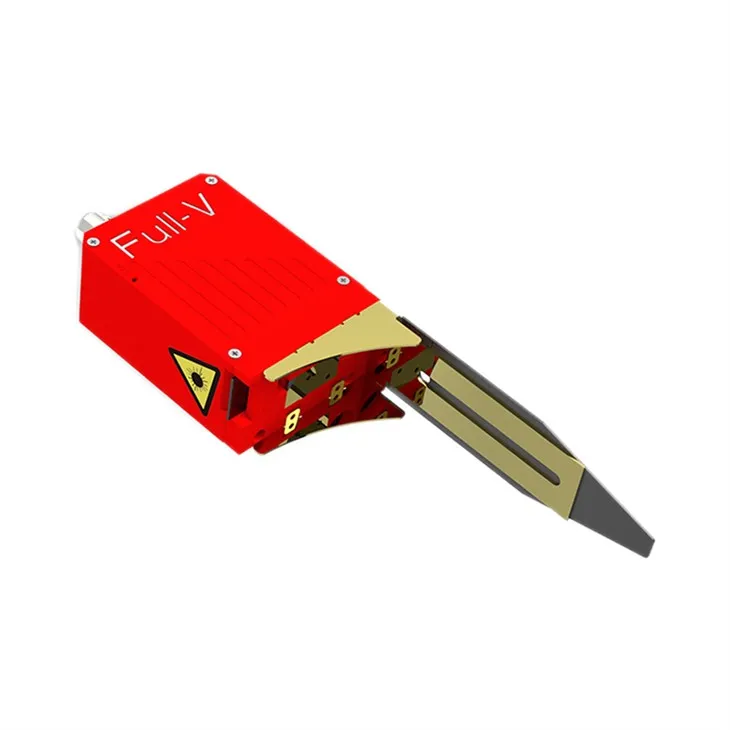
In industrial manufacturing, image segmentation plays a crucial role in quality control. Our intelligent vision solutions use image segmentation to detect defects on products. For example, in the welding process, we can use image segmentation to identify the weld seam. The Butt Series Laser Weld Tracking Sensor FV - 150 - ZO - TD and Butt Series Laser Weld Tracking Sensor FV - 210 - ZO - TD are equipped with advanced image segmentation algorithms. These sensors can segment the weld area from the surrounding material, allowing for precise tracking and quality assessment of the weld.
Medical Imaging
In the medical field, our intelligent vision solutions use image segmentation to assist in diagnosis. For example, in magnetic resonance imaging (MRI) or computed tomography (CT) scans, segmentation can be used to separate different organs, tumors, or lesions. This helps doctors in accurately identifying and analyzing the condition of a patient.
Autonomous Vehicles
Autonomous vehicles rely on intelligent vision systems to perceive their surroundings. Image segmentation is used to identify different objects such as pedestrians, other vehicles, and traffic signs. By segmenting the image of the road scene, the vehicle's control system can make better decisions about navigation and collision avoidance.
Challenges and Future Directions
Despite the significant progress in image segmentation, there are still several challenges. One of the main challenges is the variability in images. Images can have different lighting conditions, noise levels, and object orientations, which can affect the accuracy of segmentation. Another challenge is the lack of labeled data, especially in some specialized domains.
In the future, we expect to see more advanced algorithms that can handle these challenges. For example, the integration of multiple segmentation techniques, such as combining machine learning with traditional methods, may lead to more robust and accurate segmentation. Additionally, the development of unsupervised learning algorithms for image segmentation can reduce the dependence on labeled data.
Conclusion
As a supplier of intelligent vision solutions, we are at the forefront of developing and implementing advanced image segmentation techniques. Our products, such as the Butt Series Laser Weld Tracking Sensors, are designed to provide high - quality image segmentation for various industrial applications.

If you are interested in our intelligent vision solutions and would like to discuss your specific needs for image segmentation in your industry, we invite you to reach out to us for procurement and further discussions. Our team of experts is ready to provide you with the best solutions tailored to your requirements.
References
- Gonzalez, R. C., & Woods, R. E. (2017). Digital Image Processing. Pearson.
- Goodfellow, I. J., Bengio, Y., & Courville, A. (2016). Deep Learning. MIT Press.
- Szeliski, R. (2010). Computer Vision: Algorithms and Applications. Springer.