

How do seam tracking sensors work? Well, let me break it down for you in a way that's easy to understand. As a supplier of seam tracking sensors, I've seen firsthand how these nifty devices play a crucial role in the welding industry.
First off, what's seam tracking all about? In welding, it's super important to keep the welding torch right on target along the seam. Any small deviation can lead to a weak weld, which is a big no - no, especially in industries where safety and reliability are key, like automotive or aerospace. That's where seam tracking sensors come into play. They're designed to detect the position of the seam and help the welding system adjust accordingly.
There are several types of seam tracking sensors out there, but one of the most popular ones is the laser - based sensor. Let's take a deep dive into how these laser sensors work.
A laser seam tracking sensor typically has three main components: a laser emitter, a camera or a detector, and a controller. The laser emitter is like the spotlight of the system. It sends out a laser beam that shines on the workpiece. The laser beam is usually in a line shape, which spreads across the area where the seam is expected to be.
Once the laser hits the workpiece, it reflects off the surface. This reflected light is then captured by the camera or detector. The camera is super important here because it's like the eyes of the sensor. It takes a picture of the laser line and the workpiece, and this image contains a lot of valuable information.
The controller is the brain of the operation. It analyzes the image captured by the camera. First, it looks for the shape of the laser line on the workpiece. When there's a seam, the laser line will distort because of the change in surface elevation. For example, if there's a groove or a joint, the laser line will bend or break at that point. The controller can detect these patterns and figure out exactly where the seam is located.
Based on the information about the seam's position, the controller then sends signals to the welding system. These signals tell the welding torch to move left, right, up, or down so that it stays right on top of the seam. This adjustment happens in real - time, which means that even if the workpiece moves a little during the welding process, the sensor can keep the torch on track.
Let me give you an example to make it clearer. Imagine you're welding a long, straight seam on a metal plate. As you start welding, the plate might shift slightly due to heat or vibrations. Without a seam tracking sensor, the torch would continue moving in a straight line and might end up missing the seam. But with a laser seam tracking sensor, the sensor quickly detects the shift. The laser line on the plate shows a change in the pattern, the controller analyzes it, and then it sends a signal to the torch to adjust its position. So, the welding process can continue smoothly without any interruptions.
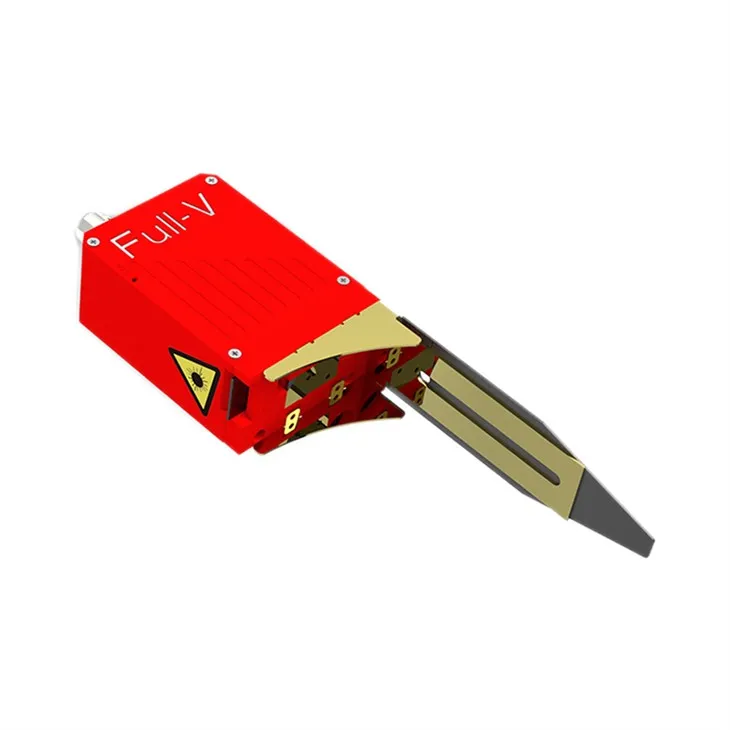
Now, let me talk about two of our great products. We have the Butt Series Laser Weld Tracking Sensor FV - 210 - ZO - TD. This sensor is really high - performance. It has a super - accurate laser emitter that can create a very clear laser line on the workpiece. The camera it comes with has a high resolution, which means it can capture very detailed images of the laser line and the seam. The controller in this sensor is very smart. It can analyze the images quickly and make precise adjustments to the welding torch. Whether you're working on thin or thick metal sheets, this sensor can handle it.
Another great option is the Butt Series Laser Weld Tracking Sensor FV - 150 - ZO - TD. It's a more compact and lightweight sensor, which is perfect if you're working in a tight space. Don't let its size fool you, though. It still has all the essential features of a good seam tracking sensor. The laser emitter is strong enough to create a visible line even in less - than - ideal lighting conditions. And the controller can do a great job of analyzing the seam position and making the necessary adjustments to the welding process.
So, why are these sensors so important? Well, for starters, they improve the quality of the welds. By keeping the torch right on the seam, you get a stronger and more consistent weld. This means fewer defects and a better - looking finished product. They also increase productivity. You don't have to stop the welding process every few minutes to check if the torch is on track. The sensor does it all for you, so you can keep welding at a steady pace. And they save money in the long run. Fewer defective welds mean less rework, which saves both time and materials.
If you're in the welding business, whether you're a small workshop or a large manufacturing plant, seam tracking sensors can make a huge difference in your operations. They're a smart investment that can pay off big time.
If you're interested in learning more about our seam tracking sensors or are thinking about making a purchase, don't hesitate to reach out. We're here to answer all your questions and help you find the perfect sensor for your needs. Whether it's the high - performance FV - 210 - ZO - TD or the compact FV - 150 - ZO - TD, we've got you covered.

References:
- Welding Handbook, American Welding Society
- Laser Sensor Technology in Industrial Applications, Journal of Industrial Sensors